We plan with specialists before life changing health decisions like surgery, chemotherapy, or dialysis.
Why not before emergencies?
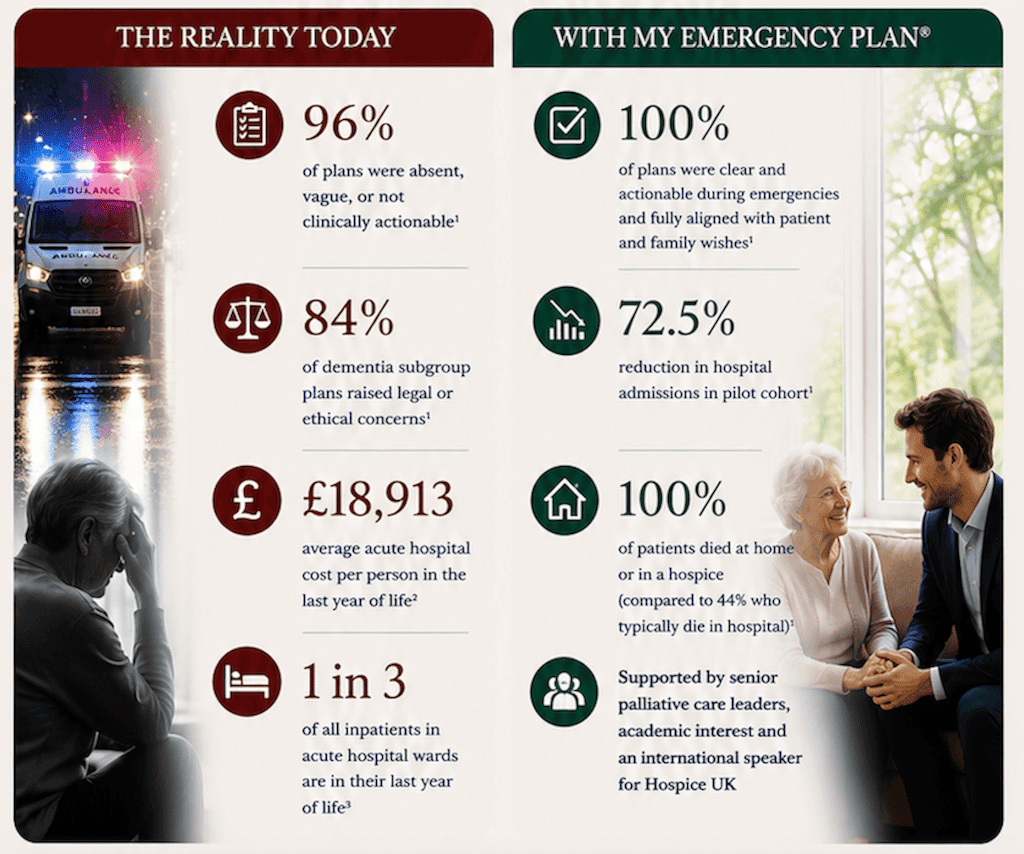
My Emergency Plan® is a scalable model that creates one-page emergency care plans to support frail and vulnerable people, while giving clinicians, carers and families clear guidance they can trust.
So when an emergency strikes, a patient’s voice is heard.
Picture someone you love:
We all know someone in a vulnerable state: in a care home, housebound, someone frail or having a dementia diagnosis.
Ask yourself:
Do you know what they would want if something went wrong tonight? Would you even know how to make an informed decision?
Would their carers, GP, out-of-hours doctor, ambulance crew or hospital team know?
Is there a clear emergency plan in place guided by a specialist that everyone can trust?
Too often the answer is no. It does not have to be this way.
Thats where My Emergency Plan® comes in to support you and your loved one.

Built from personal loss, refined through frontline experience:
Personal loss:
Dr. Gloudeman experience a deeply personal loss during medical school, when someone close to him developed a terminal illness. Even as a training doctor, our family struggled to navigate the uncertainty and stress with the many hospital trips and emergencies.
Early career:
Seeing patients and families like ours feel the same pain and uncertainty, I began to act. Over eight years, refining a model supporting one patient and family at a time.
Scale of the problem:
After taking on a role looking after a wide geographic area and personally reviewing 4,000 - 5,000 advanced care plans over a three year period (estimate based on audit data), this issue was too large solve alone.
A better way forward:
After refining a model, shaped by decade of cross-specialty NHS experience in more than ten hospital and community settings, I built My Emergency Plan® so families, carers and patients do not face that uncertainty unprepared.
What Clinical Leaders Are Saying:
“He brings an energy and a focus to advance care planning which I find really refreshing and energising.”
- Professor Max Watson MBE, Hospice UK Clinical ECHO introduction
“This is a much-needed service. Having worked alongside Dr Gloudeman as his Hospice Consultant and Medical Director, I know he will deliver this important work with both sensitivity and skill.”
- Dr Teresa Storr, Retired Consultant in Palliative Medicine with 45 years of NHS experience
Why specialist-led planning matters:
Emergency care planning involves some of the most medically, ethically and legally nuanced conversations in healthcare. Yet unlike many other high-stakes areas of medicine, there is no widely recognised specialist training, certification or quality assurance standard for this work.
It falls into a gap between hospital and community care, requiring cross-specialty understanding across both settings. Few clinicians gain this depth and breadth of experience through current training pathways.
Decisions about hospital admission, risk, comfort, capacity, best interests and family wishes should not be reduced to vague forms, rushed conversations or left until crisis strikes.
My Emergency Plan® provides clear, specialist-led guidance before an emergency happens.